
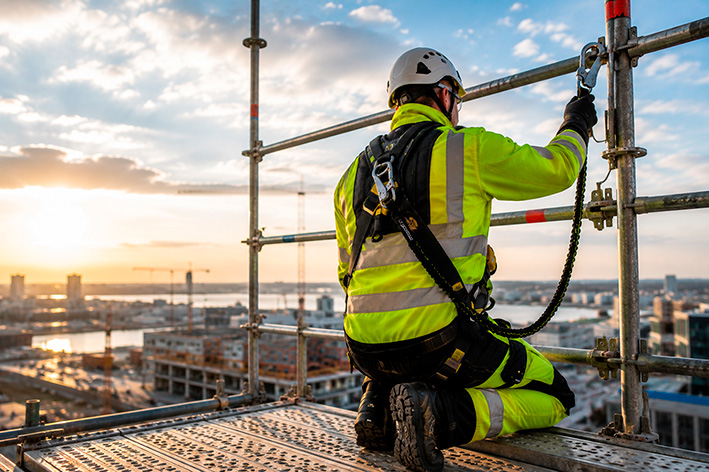
The working day begins like many others. The construction site is in full swing, deadlines are looming, and the day’s tasks are waiting to be tackled. An employee climbs onto the scaffolding to carry out a familiar task. The work feels like a routine, and there appears to be nothing out of the ordinary about the situation.
Then something unexpected happens.
Your footing gives way, safety measures are inadequate, or working conditions change in an instant. The consequences can be serious – and in the worst cases, fatal.
Many falls occur precisely when the work feels familiar and safe.
When working at height, there is no room for assumptions
Working at height is a daily occurrence in construction, industry and maintenance work. That is precisely why the risks are sometimes underestimated.
Typical hazardous situations are caused, for example, by:
- inadequate fall protection
- incorrect use of scaffolding
- haste and carelessness
- changing weather conditions
- inadequate risk assessment
Even if the equipment is in good working order, safety ultimately also depends on whether employees are able to identify hazards in good time and respond appropriately in different situations.
Safety is built on expertise
When it comes to health and safety at work, the focus is often on equipment, inspections and regulations. These are important, but they are not enough on their own.
Working safely starts with the employee understanding:
- what are the risks involved in the job
- how they can be prevented
- when work should be suspended
- how to use protective equipment correctly
- what to do if circumstances change
When skills are up to standard, safe working practices also become part of everyday work.
The responsibility lies with the whole workplace
Employers have a duty to ensure the safety of their employees and to provide them with adequate induction training. At the same time, every employee has a responsibility to follow safe working practices and to report any risks they identify.
The best results are achieved when safety is seen as a shared responsibility – not just a mandatory obligation.
A single day of training can prevent a serious accident
Falls cannot always be completely eliminated, but they can be effectively prevented.
In training for work involving scaffolding and the risk of falling, participants learn to identify risks, use the correct working methods and work safely at height.
Safety isn’t just about rules and regulations. It’s about ensuring that every working day is a success, so that everyone gets home safely at the end of the day.